The wonder of Zelda

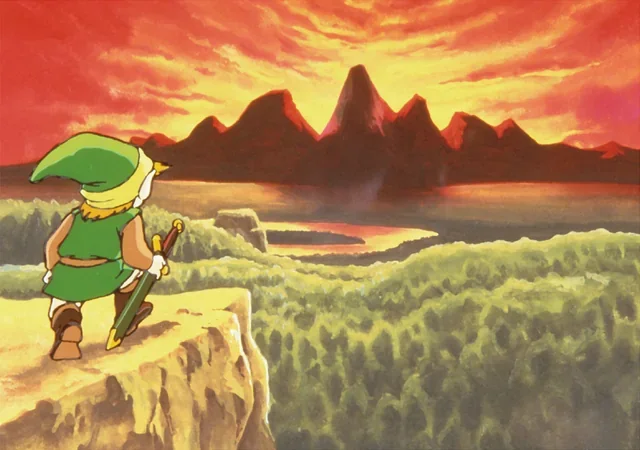
The Zelda series is anything but coherent to me. You’ve got both seminal 2D-titles A Link to the Past and Link’s Awakening among others, you’ve got the Ocarina of Time-likes ending with Skyward Sword, and you’ve got the open world Zeldas. Oh, and one strange RPG-platformer hybrid. I guess.
Yes, that means I talk about the original The Legend of Zelda in the same breath as… Breath of the Wild and Tears of the Kingdom. If I’m really honest, I’d even… tear it away from those two. (OK, I’ll stop now.) The Legend of Zelda has a strange frontier-like vibe, that even Breath and Tears don’t really manage. I think it mostly comes down to the fact that Breath and Tears have people and villages in them.
In Legend there are only a handful of old people and some merchants that help and hinder you, but there is no safe space. Everywhere you go, trouble and mystery are present. In comparison, walk into Breath’s Hateno Village and you’d be forgiven for thinking Calamity Ganon was soundly defeated a century ago. In Legend however, it feels like the land is rough, strange, anything but your home. Interestingly, it’s Zelda II (the strange RPG-platformer hybrid) that cements this as it contains a little Easter egg, by including the entirety of the Legend map as an isolated corner in the far-flung reaches of Hyrule.
But that specific frontier vibe… it’s what keeps me going in Zelda.
It’s why I loved Link’s Awakening, because while it does present you with villages and a population, it drenches everything in mystery and uncanniness. Koholint Island is not your home; it does not become one either. That’s essential to the game. That liminal quality works as the main drive within the Zelda-franchise.
While I don’t like the Ocarina-style games, Ocarina of Time does play with this. The way it presents Hyrule Field and its various areas do feel like they would facilitate this, but by literally giving Link a home (albeit a unnatural one), you feel more or less anchored to the game’s world.
Breath starts out with this quality by simply feeding you two tablespoons of amnesiac, but the more you remember and uncover, the more it breaks down that frontier flavour. You as a player are uncovering stuff, but Link is remembering. The longer you play, the more you and Link drift apart. Tears by its very nature can’t even do this. You are now fully embedded into the world, and a result it then adds two tablespoons of amnesiac to the game’s setting instead. It contorts in ways that may provide a fun game, but its vibe is one of thrills rather than one of wonder and mystery.
Yes, the weapon degradation adds flavour here, but it happens so incredibly fast, far beyond any reason, that it detracts and takes you out of it. I like the idea of weapon degradation and I certainly would have appreciated rusted weapons breaking within a few hits, or even immediately cracking at the first blow, but the way every weapon seems to be made of sugar is just aggravating. More survival elements, like whetting your blades or repairing your bows would have gone a long way to alleviating this issue and strengthening the vibe.
There are also a few pangs of unreasonable betrayal in this feeling I have. When that first trailer of The Wind Waker was shown, I wasn’t focusing on Link’s design. No, I was entranced by its environments instead. These looked like dungeon walls and doors from the original Legend! The idea of returning to that initial open world was enticing to me. Alas, we got a boat in a far more comfortable world instead. That was the first let-down.
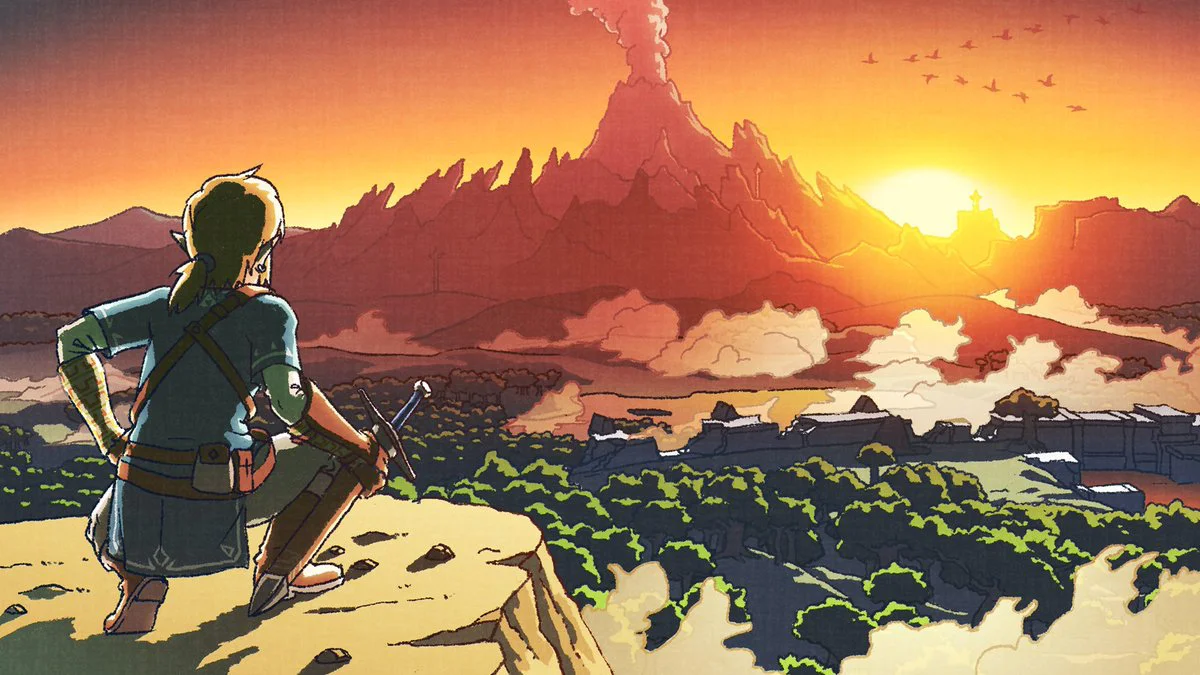
The second came years later with Breath of the Wild. Seeing the first trailer for that one, basically mimicking the artwork of the original (see the images above and below), got me unreasonably hyped. And while the Great Plateau was excellent, the vibe quickly broke down afterwards.
So, why does the first game Legend work so well for me? First, you can basically go everywhere. What is now called the Lost Woods section requires some knowledge or trial and error to get through, but it won’t actually keep you from exploring beyond your power level. You can get to every ‘screen’ from the get-go.
Second, the grid based design of the game facilitates an innate form of mystery. Every tile in the 2D grid is a potential point of interaction. This doesn’t really work in 3D games where polygons rule. Not every polygon face is a potential point of interaction. If it were, it would be a kin to being able to interact with every grain of sand in the desert, it would become overwhelming. A 2D grid like in most Famicom/NES games is mildly overwhelming. Checking every tile is a lot of work, but insanely so. That means that every tile is a potential and viable mystery. Both the tile-based nature and it’s open world enhance each other here: the world itself is a huge dungeon as a result and not merely a liminal space.
Third, there is a sense of resource management present that is simplistic but flavourful. You have “unlimited” arrows, but shooting one simply deducts a rupee from your currency. It’s probably a technical limitation, but also brilliant design. Later games in the series have gone back to buying separate arrows, but really, this specific instance is just chef’s kiss. Bombs and keys are more traditional, but the way they work, is that both are not a finite resource. For bombs this is pretty normal, but for keys, this feels weird. The Zelda-series has conditioned us into thinking that each dungeon has a limited amount of keys that only work within that dungeon. Legend simply doesn’t use that notion. Every key can work everywhere and can simply be stocked. You can even get a skeleton key that will work on all doors.
Thus getting stuck or failing to pass through the dungeon can be alleviated by spending money. If you’re skilful, you can get by with minimal resources, if you’re not, you’ll need money to compensate, which you can get by defeating enemies and becoming more skilful. I’m not going to compare it openly to another series which does this and is appreciated for its flow and vibe, but suffice to say it ends in ‘-ouls’.
Speaking of, the way the story unfolds is also more akin to what I appreciated in the Metroid series. The first three Metroids know when to shut up and instead let the environment and its creatures do the talking. Legend is pretty much the same. There really isn’t a story to speak of, but the interactions you have and the areas you uncover tell something. Something you can flesh out in your mind, fill in the gaps, add what little you know from the manual and create a story that feels more real than it should be. What exactly is it about that eastmost peninsula anyway?
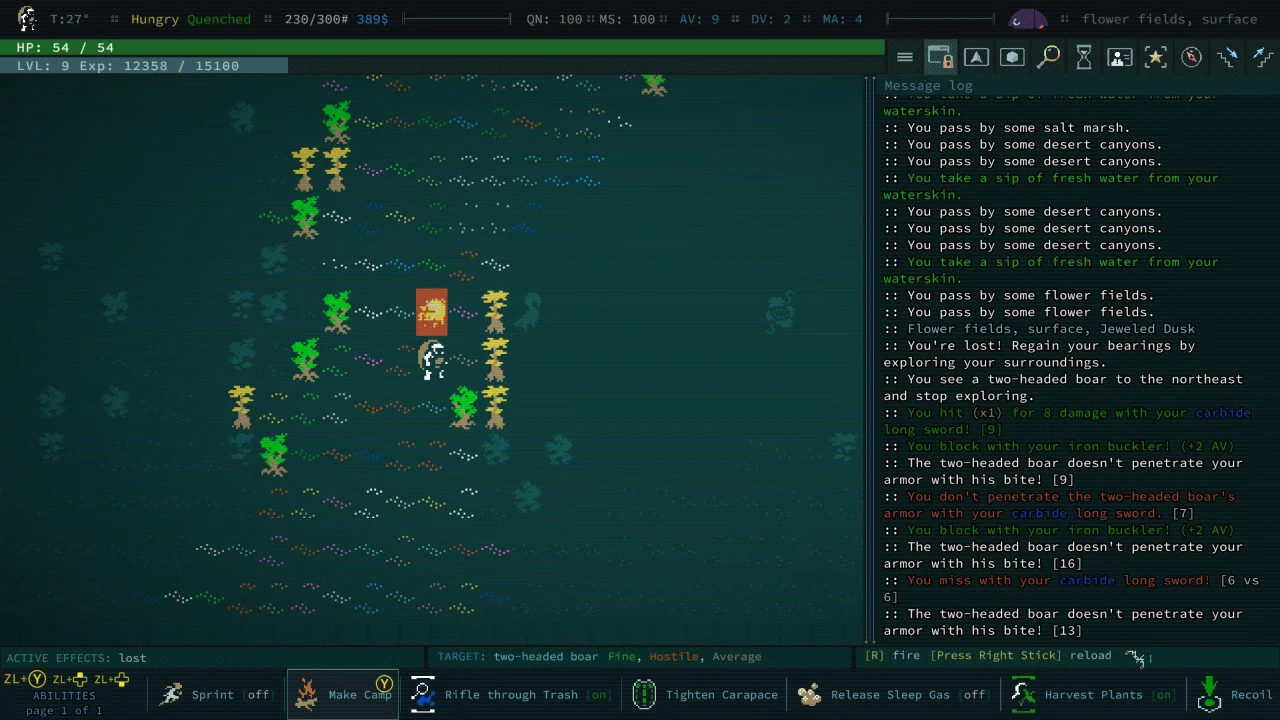
All to say, that I am currently deeply and utterly in love with Caves of Qud. Its mysterious world, survival elements, and randomly generated environments aren’t similar to The Legend of Zelda. But it does manage to have that frontier-vibe. To not have a home and venture out into the open. To get by on a minimum of resources. To literally gain access to more money than you can carry. To look out over the map and simply wonder. And then to wander there.
But it's turn-based. Its ASCII-like graphics will probably make grown men cry and run for the DLSS5 hills. Its nihilistically brutal, killing you because of a bad roll. At certain times it out'-ouls' that aforementioned '-ouls' series. It's a very peculiar flavour of freedom that Qud provides. One that is not like Legend or the Zelda-series at all. More akin to the spirit of the '80s where Elite and Ultima ruled.
Yet, Caves of Qud did remind me of Legend, of its vibe. And in doing so basically generated a craving in me: to have the simplistic action-RPG combat of Zelda (or Secret of Mana), combined with a world steeped in light survival elements, devoid of civilisation, and with a single simple quest in the back of my mind.
I mean, the Zelda series is incoherent enough already. Let's push it a bit further, shall we? It'll be wondrous.